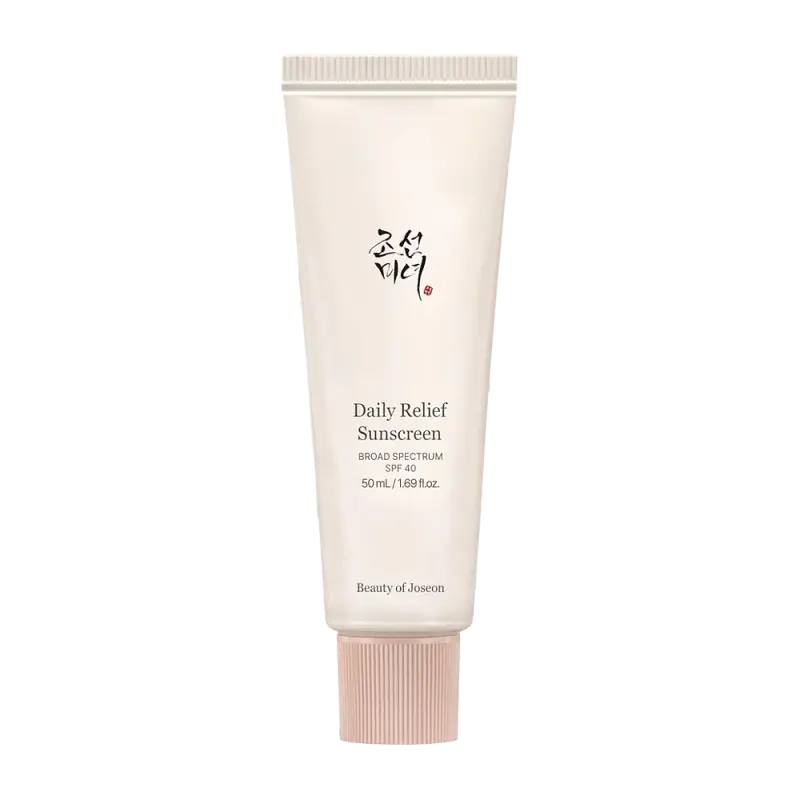
Beauty of Joseon Daily Relief Sunscreen SPF 40 by Beauty of Joseon
Beauty of Joseon

Beauty of Joseon Daily Relief Sunscreen SPF 40

Sunscreens

Safety score

Pregnancy-focused assessment

Medium Risk51/100
Higher concernLower concern

This formula contains an ingredient that needs extra caution in MamaSkin's pregnancy-focused assessment.

Formula and assessment check

Ingredient safety review updated 15 February 2026. Product formulas can change, so compare the ingredients shown here with the packaging you have.

Report a formula mismatch

Ingredient breakdown

See how the listed formula falls across MamaSkin's pregnancy-focused risk bands.

25

No known risks

2

Low risk

3

Medium risk

0

High risk

Ingredients

Ingredients with a higher risk flag appear first, followed by the rest of the formula.

Butyl Methoxydibenzoylmethane

Medium Risk

Butyl methoxydibenzoylmethane (avobenzone) is a UVA filter used in sunscreens. Reviews note potential endocrine-related signals for several organic UV filters, but data are often not sufficient to establish endocrine disruption, and systemic exposure depends on formulation and use pattern. Pregnancy-specific human outcome data for topical exposure are limited; the key signal is uncertainty around systemic/endocrine effects rather than a well-defined pregnancy outcome dataset.

Sources: TGA: Safety review of seven active sunscreen ingredients https://www.tga.gov.au/resources/publication/corporate-reports/safety-review-seven-active-sunscreen-ingredients
Homosalate

Medium Risk

Homosalate is a UV-B filter. SCCS re-evaluations focused on potential endocrine activity and systemic exposure; while endocrine evidence has been described as inconclusive/equivocal, the ingredient remains under endocrine-disruptor scrutiny and exposure modelling depends on product type and use patterns. Pregnancy-specific human outcome data for topical exposure are limited, so the key signal is endocrine uncertainty plus systemic exposure considerations with frequent, large-area use.

Sources: SCCS: Homosalate safety assessment https://health.ec.europa.eu/publications/scientific-advice-safety-homosalate-cas-no-118-56-9-ec-no-204-260-8-uv-filter-cosmetic-products_en

Octocrylene

Medium Risk

Octocrylene is a UV filter and photostabiliser used in sunscreens and some daily SPF products. SCCS reviewed endocrine-related evidence and noted some indications of endocrine effects in vivo, but with limitations; systemic exposure is plausible with frequent, large-area use. An additional practical signal is that benzophenone can occur as an impurity/degradation product in some octocrylene-containing products. Pregnancy-specific human outcome data for topical exposure are limited.

Sources: SCCS/1627/21: Octocrylene https://health.ec.europa.eu/publications/octocrylene_en

Show all (30)

Ethylhexyl Salicylate

Low Risk

Ethylhexyl salicylate (octisalate) is an organic UV-B filter with measurable topical absorption. A CIR review records a rat oral reproductive/developmental study with dose-related post-implantation loss and smaller litters at 80 and 250 mg/kg/day (NOAEL 25 mg/kg/day); those repeated oral doses do not model intact-skin cosmetic exposure. The same review found relatively low human-skin permeability and concluded ethylhexyl salicylate safe in the assessed cosmetic uses. A ToxCast-to-human-exposure comparison found the most sensitive in-vitro endocrine response at about 16.5 micromolar versus about 0.023 micromolar maximal-use human plasma exposure, roughly 700-fold lower. FDA still requests additional sunscreen safety data, and pregnancy-outcome data are limited; MotherToBaby reports no proven increased pregnancy risk. MamaSkin therefore uses Low Risk to surface absorption and the evidence gap without treating remote high-dose animal findings as proof that typical topical use should be avoided.

Sources: CIR 2019 Final Report: Amended Safety Assessment of Salicylic Acid and Salicylates https://www.cir-safety.org/sites/default/files/salicy042019FAR.pdf, Toxicological Sciences 2023: ToxCast/Tox21 endocrine activity compared with human plasma exposure https://academic.oup.com/toxsci/article/196/1/25/7240499, FDA: OTC sunscreen proposed-order Q&A https://www.fda.gov/drugs/understanding-over-counter-medicines/questions-and-answers-fda-posts-deemed-final-order-and-proposed-order-over-counter-sunscreen, Matta et al. JAMA 2020 maximal-use sunscreen absorption trial https://jamanetwork.com/journals/jama/fullarticle/2759002, MotherToBaby: Screening Your Sunscreen During Pregnancy https://mothertobaby.org/baby-blog/screening-your-sunscreen-during-pregnancy/

Butyloctyl Salicylate

Low Risk

Butyloctyl salicylate is a salicylate ester that the CIR panel considered safe as used in cosmetics when formulated to be non-irritating. Available safety data support low dermal toxicity, and at typical cosmetic use levels the expected systemic salicylate exposure from topical application is far below oral salicylate exposure, which fits a low-risk classification.

Sources: MotherToBaby: Topical acne treatments including salicylic acid https://www.ncbi.nlm.nih.gov/books/NBK582985/

1,2-Hexanediol

No Known Risks

1,2-Hexanediol is commonly used as a solvent and preservative booster; topical exposure is low and it has no known pregnancy or breastfeeding concerns at cosmetic concentrations, though very sensitive skin may occasionally react.

Sources: CIR; EU/UK Cosmetics Regulation

Acrylates/C10-30 Alkyl Acrylate Crosspolymer

No Known Risks

Polymer thickener and stabiliser used in creams and sunscreens. Low systemic exposure expected.

Sources: Cosmetic Ingredient Review (US); Scientific Committee on Consumer Safety (EU)

Behenyl Alcohol

No Known Risks

Long-chain fatty alcohol used as an emollient and thickener. This is not the same concern profile as simple drying alcohols; reviewed cosmetic safety sources support normal topical use.

Sources: CIR: Final Report on the Safety Assessment of Cetearyl Alcohol, Cetyl Alcohol, Isostearyl Alcohol, Myristyl Alcohol, and Behenyl Alcohol; EU CosIng / cosmetics regulatory inventory

Caprylyl Methicone

No Known Risks

Volatile/low-residue silicone emollient used to improve spreadability and sensory feel. Reviewed cosmetic safety sources support normal topical use, with no pregnancy- or breastfeeding-specific topical signal identified in the material reviewed.

Sources: CIR: Amended Safety Assessment of Dimethicone, Methicone, and Substituted-Methicone Polymers as Used in Cosmetics; EU CosIng / cosmetics regulatory inventory

Carbomer

No Known Risks

Polymer thickener used to create gel textures. Large-molecule ingredient with negligible systemic absorption.

Sources: Cosmetic Ingredient Review (US); Scientific Committee on Consumer Safety (EU)

Cetearyl Alcohol

No Known Risks

Fatty alcohol used as an emollient and thickener. Not the same as drying alcohols and not associated with pregnancy-specific concerns.

Sources: Cosmetic Ingredient Review (US); Scientific Committee on Consumer Safety (EU)

Diethylhexyl 2,6-Naphthalate

No Known Risks

Diethylhexyl 2,6-naphthalate is an emollient, solvent and cosmetic photostabiliser. FDA formulation-review material cites a CIR safe-use conclusion, and Health Canada lists it for topical non-medicinal use. Photochemical activity in isolated solvent systems does not establish reproductive or developmental toxicity in a finished cosmetic. No pregnancy-specific concern was identified for normal topical use.

Sources: US FDA MUsT formulation safety review citing CIR safe-use conclusions https://downloads.regulations.gov/FDA-1978-N-0018-15871/attachment_1.pdf; Health Canada NHPID topical non-medicinal identity https://webprod.hc-sc.gc.ca/nhpid-bdipsn/ingredReq?id=14889.

Dipropylene Glycol

No Known Risks

Dipropylene glycol is used as a solvent and carrier in cosmetics; topical exposure is low and it has no known pregnancy or breastfeeding concerns at cosmetic concentrations.

Sources: CIR; EU/UK Cosmetics Regulation

Ethylhexylglycerin

No Known Risks

Preservative booster and skin-conditioning agent. Considered safe for cosmetic use with low systemic exposure when used as intended.

Sources: Scientific Committee on Consumer Safety (EU); Cosmetic Ingredient Review (US)

Glycerin

No Known Risks

Glycerin is a widely used humectant that supports hydration and the skin barrier, with a long safety record and no known pregnancy or breastfeeding concerns in topical cosmetic use.

Sources: CIR; EU/UK Cosmetics Regulation

Glyceryl Stearate

No Known Risks

Emulsifier and emollient used to stabilise creams and lotions. Not associated with pregnancy-specific concerns at cosmetic exposure.

Sources: Cosmetic Ingredient Review (US); Scientific Committee on Consumer Safety (EU)

Inulin Lauryl Carbamate

No Known Risks

A sugar, starch, inulin or cellulose derivative used for emulsification, film formation, absorbency or formula texture. These carbohydrate-based materials are not expected to produce meaningful systemic exposure through intact skin, and related cosmetic safety assessments do not identify a reproductive or developmental hazard for normal use. Fine dry powder should not be deliberately inhaled.

Sources: CIR safety assessments of Starches and Modified Starches, Cellulose and Cellulose Derivatives, Saccharide Esters and Plant Polysaccharide Gums; CIR December 2025 Quick Reference Table https://cir-safety.org/sites/default/files/QRT-Update-Dec2025.pdf; European Commission CosIng ingredient inventory.

Oryza Sativa Extract

No Known Risks

A rice-derived extract or wax used for skin conditioning, absorbency or texture. Cosmetic safety reviewers concluded that the assessed Oryza sativa-derived ingredients are safe in current cosmetic practices. Rice allergy remains possible in a susceptible person.

Sources: CIR: Rice-derived ingredients conclusions, IJT 25(Suppl. 2), 2006; December 2025 Quick Reference Table https://cir-safety.org/sites/default/files/QRT-Update-Dec2025.pdf

Pentylene Glycol

No Known Risks

Humectant and preservative booster. Considered safe for cosmetic use with low systemic exposure.

Sources: Cosmetic Ingredient Review (US); Scientific Committee on Consumer Safety (EU)

Poly C10-30 Alkyl Acrylate

No Known Risks

A high-molecular-weight acrylate polymer used as a film former and texture modifier. Its high molecular weight limits meaningful skin penetration. No reproductive or developmental hazard was identified for normal topical cosmetic exposure.

Sources: European Commission CosIng ingredient inventory; Cosmetic Ingredient Review botanical safety-assessment framework and relevant ingredient-family assessments. No ingredient-specific human pregnancy study of normal topical cosmetic use was identified.

Polyacrylate Crosspolymer-6

No Known Risks

Large polymer thickener and stabilizer used in gels, serums and creams. Systemic exposure from topical cosmetic use is expected to be low, with no pregnancy- or breastfeeding-specific concern identified in reviewed cosmetic references.

Sources: CIR cosmetic ingredient safety references for acrylates/polyacrylate crosspolymers; EU CosIng / cosmetics regulatory inventory

Polyglyceryl-3 Methylglucose Distearate

No Known Risks

An emulsifier built from polyglycerin, methyl glucose and stearic-acid components, used to stabilise creams and improve texture. Exact pregnancy-specific data are limited. Cosmetic safety reviewers concluded that related methyl glucose esters and polyglyceryl fatty-acid esters are safe in current cosmetic use when formulated to be non-irritating. No pregnancy-specific topical concern was identified by applying those related-group assessments to ordinary cosmetic exposure.

Sources: CIR: Safety Assessment of Methyl Glucose Polyethers and Esters https://www.cir-safety.org/supplementaldoc/safety-assessment-methyl-glucose-polyethers-and-esters-used-cosmetics; CIR: Safety Assessment of Polyglyceryl Fatty Acid Esters https://cir-safety.org/sites/default/files/PGlyFE092016FR.pdf

Polymethylsilsesquioxane

No Known Risks

A silicone resin used as a film former, texture enhancer and opacifying ingredient in makeup, sunscreen and skin care. The Cosmetic Ingredient Review concluded that polysilsesquioxanes including Polymethylsilsesquioxane are safe in current cosmetic use. Available evidence does not identify a pregnancy- or breastfeeding-specific concern for normal topical cosmetic exposure.

Sources: CIR: Safety Assessment of Polysilsesquioxanes as Used in Cosmetics (Final Report) https://cir-safety.org/sites/default/files/PLYSIL122017FR.pdf

Silica

No Known Risks

Mineral absorbent and texture aid used to mattify and improve slip. Reviewed cosmetic safety sources support normal topical cosmetic use; this assessment does not cover deliberate inhalation of loose powder.

Sources: CIR: Safety Assessment of Silica and Silicates as Used in Cosmetics; EU CosIng / cosmetics regulatory inventory

Sodium Stearoyl Glutamate

No Known Risks

Amino-acid-derived emulsifier and skin-conditioning support ingredient. Reviewed cosmetic ingredient references do not identify a pregnancy- or breastfeeding-specific concern for normal topical use.

Sources: CIR cosmetic ingredient safety references for amino acid alkyl amides/salts; EU CosIng / cosmetics regulatory inventory

T-Butyl Alcohol

No Known Risks

A volatile solvent and denaturant used in small amounts in cosmetics. Cosmetic safety reviewers concluded that t-butyl alcohol is safe in current practices of use and concentration; their assessment included reproductive and developmental data and found a large exposure margin at cosmetic use levels. It may irritate eyes or skin in concentrated form.

Sources: CIR: Amended Safety Assessment of t-Butyl Alcohol as Used in Cosmetics https://cir-safety.org/sites/default/files/FAR_t-ButylAlcohol_092024.pdf

Tocopherol

No Known Risks

Vitamin E antioxidant used to protect oils and support the skin barrier. Not associated with pregnancy-specific concerns at cosmetic exposure.

Sources: Cosmetic Ingredient Review (US); Scientific Committee on Consumer Safety (EU)

Tromethamine

No Known Risks

pH adjuster and buffer used to stabilise formulations. Reviewed cosmetic safety sources support normal topical use, with no pregnancy- or breastfeeding-specific topical signal identified in the material reviewed.

Sources: CIR: Safety Assessment of Tromethamine as Used in Cosmetics; EU CosIng / cosmetics regulatory inventory

Vp/Eicosene Copolymer

No Known Risks

A film-forming vinyl polymer used for water resistance and product hold. Cosmetic safety reviewers concluded that vinylpyrrolidone polymers, including VP/eicosene copolymer, are safe in current practices when residual monomers are appropriately controlled. Rare contact allergy has been reported with this ingredient family.

Sources: CIR: Safety Assessment of Vinylpyrrolidone Polymers as Used in Cosmetics https://www.cir-safety.org/sites/default/files/vinylp122018final.pdf

Water

No Known Risks

Formulations can change without notice. For the most accurate result, compare this list with your packaging and scan the exact ingredient label in MamaSkin when you repurchase.

How to use this assessment

The risk band is the primary conclusion. The score adds detail within that band and should not be used to compare products as if a one-point difference were clinically meaningful.

MamaSkin provides pregnancy-focused information, not medical advice. Your midwife, GP, pharmacist or dermatologist should take priority when your circumstances differ from typical cosmetic use.

Read the full methodology