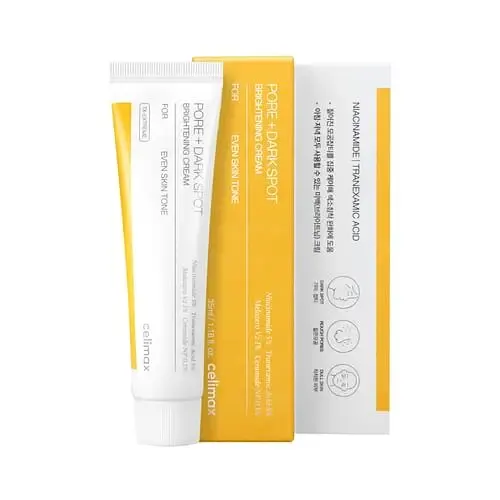
Celimax Pore + Dark Spot Brightening Cream by Celimax
Celimax

Celimax Pore + Dark Spot Brightening Cream

General Moisturizersmoisturisers

Safety score

Pregnancy-focused assessment

Low Risk75/100
Higher concernLower concern

One or more ingredients have a low-risk flag in MamaSkin's current assessment. Review the notes and your own circumstances.

Formula and assessment check

Ingredient safety review updated 9 December 2025. Product formulas can change, so compare the ingredients shown here with the packaging you have.

Report a formula mismatch

Ingredient breakdown

See how the listed formula falls across MamaSkin's pregnancy-focused risk bands.

43

No known risks

3

Low risk

0

Medium risk

0

High risk

Ingredients

Ingredients with a higher risk flag appear first, followed by the rest of the formula.

Tranexamic Acid

Low Risk

Synthetic lysine analogue used topically for melasma and hyperpigmentation; inhibits plasmin activity and downstream melanogenesis. Topical formulations (≈2–5%) show low systemic absorption and no reported teratogenic effects, but pregnancy-specific data remain limited. Many sources regard it as pregnancy-safe or acceptable, while some advise cautious use or deferral until after pregnancy due to limited evidence.

Sources: PubMed: Topical tranexamic acid dermatology literature https://pubmed.ncbi.nlm.nih.gov/?term=topical+tranexamic+acid+melasma+safety
Vinyldimethicone

Low Risk

This ingredient is a silicone polymer included in CIR's dimethicone, methicone and substituted-methicone family assessment. CIR concluded the reviewed ingredients safe as used when formulated to be non-irritating to skin and eyes. This is family-level cosmetic evidence, not ingredient-specific human pregnancy evidence for every derivative. MamaSkin therefore retains Low Risk without claiming negligible absorption for this individual ingredient.

Sources: CIR: Amended safety assessment of dimethicone and related methicone polymers https://cir-safety.org/supplementaldoc/amended-safety-assessment-dimethicone-methicone-and-substituted-methicone-polymers-2

Coptis Japonica Root Extract

Low Risk

Coptis japonica root contains isoquinoline alkaloids including berberine. Oral berberine has limited pregnancy data and precautionary concerns involving uterine activity and bilirubin displacement, while breastfeeding exposure is also discouraged. A cosmetic extract is used topically at much lower exposure and may vary in composition, so MamaSkin applies a precautionary Low Risk classification rather than an oral-supplement-level warning.

Sources: PubMed: Coptis japonica root-derived alkaloids including berberine, palmatine and coptisine https://pubmed.ncbi.nlm.nih.gov/10552394/; MotherToBaby: Berberine https://www.ncbi.nlm.nih.gov/books/NBK600384/; European Commission CosIng ingredient inventory.

Show all (46)

Water

No Known Risks

Glycerin

No Known Risks

Glycerin is a widely used humectant that supports hydration and the skin barrier, with a long safety record and no known pregnancy or breastfeeding concerns in topical cosmetic use.

Sources: CIR; EU/UK Cosmetics Regulation

Niacinamide

No Known Risks

Niacinamide (vitamin B3) is widely used for barrier support and tone/texture benefits, and is generally considered safe in pregnancy and breastfeeding when used topically at cosmetic concentrations.

Sources: CIR; EU/UK Cosmetics Regulation

Caprylic/Capric Triglyceride

No Known Risks

Common emollient derived from fatty acids and glycerin. Used to soften skin and improve texture without pregnancy-specific concerns.

Sources: Cosmetic Ingredient Review (US); Scientific Committee on Consumer Safety (EU)

Dipropylene Glycol

No Known Risks

Dipropylene glycol is used as a solvent and carrier in cosmetics; topical exposure is low and it has no known pregnancy or breastfeeding concerns at cosmetic concentrations.

Sources: CIR; EU/UK Cosmetics Regulation

1,2-Hexanediol

No Known Risks

1,2-Hexanediol is commonly used as a solvent and preservative booster; topical exposure is low and it has no known pregnancy or breastfeeding concerns at cosmetic concentrations, though very sensitive skin may occasionally react.

Sources: CIR; EU/UK Cosmetics Regulation

Hydrogenated Poly(C6-14 Olefin)

No Known Risks

A large hydrogenated hydrocarbon polymer used as an emollient and texture agent. Cosmetic safety reviewers assessed hydrogenated poly(C6-14 olefin) with cosmetic polyenes and concluded that the group is safe in current practices of use and concentration. Dermal absorption is expected to be limited by molecular size.

Sources: CIR: Safety Assessment of Polyene Group as Used in Cosmetics https://journals.sagepub.com/doi/10.1177/1091581820952385

Phenyl Trimethicone

No Known Risks

Silicone emollient used to improve slip, gloss, and water resistance. Reviewed cosmetic safety sources support normal topical use, with no pregnancy- or breastfeeding-specific topical signal identified in the material reviewed.

Sources: CIR: Safety Assessment of Phenyl-Substituted Methicones as Used in Cosmetics; EU CosIng / cosmetics regulatory inventory

Macadamia Integrifolia Seed Oil

No Known Risks

A plant-derived fatty oil or butter used mainly as an emollient, conditioning ingredient or texture agent. Cosmetic safety reviewers concluded that the assessed plant-derived fatty acid oils are safe in current practices of use and concentration. This conclusion applies to cosmetic-grade fixed oils rather than similarly named volatile essential oils. Seed or food allergy may still matter for a susceptible person.

Sources: CIR: Safety Assessment of Plant-Derived Fatty Acid Oils as Used in Cosmetics https://cir-reports.cir-safety.org/view-attachment/?id=ad62ac6b-8e74-ec11-8943-0022482f06a6

Dicaprylyl Ether

No Known Risks

A lightweight fatty ether used as an emollient and spreading agent. Cosmetic safety reviewers concluded that dicaprylyl ether is safe in current cosmetic use; reviewed developmental testing did not identify maternal or fetal toxicity and skin absorption was low. Safety for airbrush delivery was not established.

Sources: CIR: Safety Assessment of Fatty Ethers https://www.cir-safety.org/sites/default/files/FR_FattyEthers_122022.pdf

Cetearyl Alcohol

No Known Risks

Fatty alcohol used as an emollient and thickener. Not the same as drying alcohols and not associated with pregnancy-specific concerns.

Sources: Cosmetic Ingredient Review (US); Scientific Committee on Consumer Safety (EU)

Propanediol

No Known Risks

Solvent and humectant used to improve texture and ingredient solubility. Low systemic exposure expected from topical cosmetic use.

Sources: Cosmetic Ingredient Review (US); Scientific Committee on Consumer Safety (EU)

Cetearyl Olivate

No Known Risks

Emollient ester/emulsifier used to improve skin feel and stabilise emulsions. Reviewed cosmetic safety sources support topical cosmetic use; the relevant practical caveat is formulation irritation potential rather than a pregnancy-specific concern.

Sources: CIR: Amended Safety Assessment of Alkyl Esters as Used in Cosmetics; CIR Quick Reference Table (Cetearyl Olivate); EU CosIng / cosmetics regulatory inventory

Glyceryl Stearate Se

No Known Risks

Self-emulsifying form of glyceryl stearate used to stabilize creams and lotions. Reviewed cosmetic safety sources support normal topical use, with no pregnancy- or breastfeeding-specific concern identified.

Sources: CIR cosmetic ingredient safety references for glyceryl stearate and self-emulsifying emulsifiers; EU CosIng / cosmetics regulatory inventory

Sorbitan Olivate

No Known Risks

Olive-derived sorbitan ester used as an emulsifier and skin-conditioning ingredient. Reviewed cosmetic safety references do not identify a pregnancy- or breastfeeding-specific concern for normal topical use.

Sources: CIR: Safety Assessment of Sorbitan Esters as Used in Cosmetics; EU CosIng / cosmetics regulatory inventory

Ammonium Acryloyldimethyltaurate/Vp Copolymer

No Known Risks

Polymer thickener used to stabilise emulsions. Large-molecule ingredient with low systemic absorption.

Sources: Cosmetic Ingredient Review (US); Scientific Committee on Consumer Safety (EU)

Behenyl Alcohol

No Known Risks

Long-chain fatty alcohol used as an emollient and thickener. This is not the same concern profile as simple drying alcohols; reviewed cosmetic safety sources support normal topical use.

Sources: CIR: Final Report on the Safety Assessment of Cetearyl Alcohol, Cetyl Alcohol, Isostearyl Alcohol, Myristyl Alcohol, and Behenyl Alcohol; EU CosIng / cosmetics regulatory inventory

Dimethiconol

No Known Risks

A high-molecular-weight silicone polymer used for film forming, smoothing and skin or hair conditioning. The Cosmetic Ingredient Review concluded that Dimethiconol and its assessed derivatives are safe in current cosmetic use. Its polymeric nature limits skin penetration, and available evidence does not identify a pregnancy- or breastfeeding-specific concern for normal topical exposure.

Sources: CIR: Safety Assessment of Dimethiconol and its Esters and Reaction Products; International Journal of Toxicology 36(Suppl. 3):31-50 (2017) https://cir-safety.org/ingredient/dimethiconol

Cetearyl Glucoside

No Known Risks

Sugar-based emulsifier used to stabilise creams and lotions. Reviewed cosmetic safety sources support topical cosmetic use; the relevant practical caveat is formulation irritation potential rather than a pregnancy-specific concern.

Sources: CIR: Decyl Glucoside and Other Alkyl Glucosides as Used in Cosmetics; EU CosIng / cosmetics regulatory inventory

Laminaria Japonica Extract

No Known Risks

A red or brown algae-derived ingredient used for skin conditioning, hydration or texture. Cosmetic safety reviewers concluded that Laminaria japonica extract and the assessed Chondrus crispus ingredients are safe in current practices of use and concentration. Seaweed allergy remains possible in a susceptible person.

Sources: CIR: Laminaria Japonica Extract final report, September 2019; Chondrus Crispus ingredients final report, September 2021; December 2025 Quick Reference Table https://cir-safety.org/sites/default/files/QRT-Update-Dec2025.pdf

Eclipta Prostrata Leaf Extract

No Known Risks

A botanical extract, juice or water used primarily for skin conditioning, moisturising, soothing or antioxidant support. Direct pregnancy studies of the named cosmetic material were not identified. No reproductive or developmental hazard was identified for normal topical exposure to a compliant finished cosmetic; oral herbal or medicinal use is outside this classification.

Sources: European Commission CosIng ingredient inventory; Cosmetic Ingredient Review botanical safety-assessment framework and relevant plant-family assessments. No ingredient-specific human pregnancy study of normal topical cosmetic use was identified.

Hydrogenated Lecithin

No Known Risks

Hydrogenated emulsifier used to support skin barrier feel. Not associated with pregnancy-specific concerns.

Sources: Cosmetic Ingredient Review (US)

Ceramide NP

No Known Risks

Skin-identical barrier lipid used to support the stratum corneum and reduce dryness. Reviewed cosmetic safety sources support normal topical use, with no pregnancy- or breastfeeding-specific topical signal identified in the material reviewed.

Sources: CIR: Safety Assessment of Ceramides as Used in Cosmetics; EU CosIng / cosmetics regulatory inventory

Betaine

No Known Risks

Betaine is a humectant/osmolyte used to support hydration and reduce irritation potential in formulas; it is considered low concern with no known pregnancy or breastfeeding risks in topical cosmetic use.

Sources: CIR; EU/UK Cosmetics Regulation

Ethylhexylglycerin

No Known Risks

Preservative booster and skin-conditioning agent. Considered safe for cosmetic use with low systemic exposure when used as intended.

Sources: Scientific Committee on Consumer Safety (EU); Cosmetic Ingredient Review (US)

Xanthan Gum

No Known Risks

Natural polysaccharide thickener used for stability and texture. Not associated with pregnancy-specific concerns.

Sources: European cosmetics regulatory framework

Fructooligosaccharides

No Known Risks

Short plant-derived carbohydrate chains used for skin conditioning and formula support. Cosmetic safety reviewers assessed fructooligosaccharides with plant polysaccharide gums and concluded that the group is safe in current practices. No pregnancy-specific concern was identified for normal topical cosmetic exposure.

Sources: CIR: Safety Assessment of Plant Polysaccharide Gums as Used in Cosmetics https://www.cir-safety.org/sites/default/files/plpogu092014slr.pdf

Adenosine

No Known Risks

Skin-conditioning ingredient commonly used in leave-on skincare. Reviewed cosmetic safety sources support normal topical use, with no pregnancy- or breastfeeding-specific topical signal identified in the material reviewed.

Sources: CIR: Safety Assessment of Adenosine Ingredients as Used in Cosmetics; EU CosIng / cosmetics regulatory inventory

Eriobotrya Japonica Leaf Extract

No Known Risks

eriobotrya japonica leaf extract is a botanical-derived cosmetic conditioning ingredient. The reviewed identity is not a concentrated essential oil or an oral herbal preparation. Available cosmetic evidence and expected topical exposure did not identify a pregnancy-specific contraindication, although botanical irritation or allergy remains possible.

Sources: CIR ingredient-specific and botanical-family safety assessments; CIR Quick Reference Table https://www.cir-safety.org/supplementaldoc/quick-reference-table-december-2025; European Commission CosIng

Cholesterol

No Known Risks

Skin-conditioning lipid used in barrier-support formulas, often alongside ceramides and fatty acids. Normal topical cosmetic use has no known pregnancy- or breastfeeding-specific concern identified in reviewed cosmetic references.

Sources: CIR cosmetic ingredient safety references for cholesterol and related sterols; EU CosIng / cosmetics regulatory inventory

Butylene Glycol

No Known Risks

Solvent and humectant commonly used in leave-on products. Not associated with pregnancy-specific concerns at cosmetic exposure levels.

Sources: Cosmetic Ingredient Review (US); Scientific Committee on Consumer Safety (EU)

Beta-Glucan

No Known Risks

Film-forming polysaccharide used for soothing and hydration support. Reviewed cosmetic safety sources support normal topical use, with no pregnancy- or breastfeeding-specific topical signal identified in the material reviewed.

Sources: CIR: Safety Assessment of Microbial Polysaccharide Gums as Used in Cosmetics; EU CosIng / cosmetics regulatory inventory

Mentha Viridis Extract

No Known Risks

Hydrolyzed Hyaluronic Acid

No Known Risks

Humectant and skin-conditioning ingredient in the hyaluronate family. Reviewed cosmetic safety sources support current cosmetic use, with no pregnancy- or breastfeeding-specific topical concern identified in the material reviewed.

Sources: CIR: Safety Assessment of Hyaluronates as Used in Cosmetics; EU CosIng / cosmetics regulatory inventory

Theobroma Cacao Seed Extract

No Known Risks

A cosmetic extract from an edible fruit, seed, grain, root or mushroom used for conditioning or antioxidant support. Normal topical cosmetic exposure is much lower than ordinary dietary exposure to the source material, and no pregnancy-specific hazard signal was identified. Exact extract composition varies, so source quality and individual food or plant allergy remain relevant.

Sources: European Commission CosIng ingredient inventory; CIR botanical safety framework and relevant plant-derived ingredient assessments; FDA food ingredient and GRAS inventories where applicable.

Dextrin

No Known Risks

Starch-derived polysaccharide used as a binder, film former and texture support ingredient. Reviewed cosmetic ingredient references do not identify a pregnancy- or breastfeeding-specific concern for normal topical use.

Sources: CIR cosmetic ingredient safety references for polysaccharides/starch-derived ingredients; EU CosIng / cosmetics regulatory inventory

Tocopherol

No Known Risks

Vitamin E antioxidant used to protect oils and support the skin barrier. Not associated with pregnancy-specific concerns at cosmetic exposure.

Sources: Cosmetic Ingredient Review (US); Scientific Committee on Consumer Safety (EU)

Ascorbic Acid Polypeptide

No Known Risks

ascorbic acid polypeptide is an amino acid, peptide, protein-related or glycosaminoglycan cosmetic conditioning ingredient. Expected systemic exposure from normal topical use is low, and relevant cosmetic-family assessments did not identify a pregnancy-specific concern. Manufacturing quality and residual allergenic proteins remain relevant where applicable.

Sources: CIR assessments of alpha-amino acids, plant-derived amino acids, proteins and peptides https://www.cir-safety.org/supplementaldoc/safety-assessment-%CE%B1-amino-acids-used-cosmetics; European Commission CosIng

Glyceryl Stearate

No Known Risks

Emulsifier and emollient used to stabilise creams and lotions. Not associated with pregnancy-specific concerns at cosmetic exposure.

Sources: Cosmetic Ingredient Review (US); Scientific Committee on Consumer Safety (EU)

Ceramide As

No Known Risks

A skin-identical barrier lipid used for skin and hair conditioning. Cosmetic safety reviewers concluded that Ceramide AS is safe in current cosmetic use, noting limited skin absorption and reassuring toxicity data. Cosmetic-grade material should not be sourced from bovine central nervous system tissue.

Sources: CIR: Safety Assessment of Ceramides https://www.cir-safety.org/supplementaldoc/safety-assessment-ceramides-used-cosmetics-0

Ceramide AP

No Known Risks

Skin-identical barrier lipid used to support barrier function and reduce dryness. Reviewed cosmetic safety sources support normal topical use, with no pregnancy- or breastfeeding-specific topical signal identified in the material reviewed.

Sources: CIR: Safety Assessment of Ceramides as Used in Cosmetics; EU CosIng / cosmetics regulatory inventory

Ceramide Ns

No Known Risks

A skin-identical barrier lipid used for skin and hair conditioning. Cosmetic safety reviewers concluded that Ceramide NS is safe in current cosmetic use, noting limited skin absorption and reassuring toxicity data. Cosmetic-grade material should not be sourced from bovine central nervous system tissue.

Sources: CIR: Safety Assessment of Ceramides https://cir-safety.org/sites/default/files/cerami122014tent.pdf

Ceramide EOP

No Known Risks

Skin-identical barrier lipid used to support barrier structure and reduce dryness. Reviewed cosmetic safety sources support normal topical use, with no pregnancy- or breastfeeding-specific topical signal identified in the material reviewed.

Sources: CIR: Safety Assessment of Ceramides as Used in Cosmetics; EU CosIng / cosmetics regulatory inventory

Formulations can change without notice. For the most accurate result, compare this list with your packaging and scan the exact ingredient label in MamaSkin when you repurchase.

How to use this assessment

The risk band is the primary conclusion. The score adds detail within that band and should not be used to compare products as if a one-point difference were clinically meaningful.

MamaSkin provides pregnancy-focused information, not medical advice. Your midwife, GP, pharmacist or dermatologist should take priority when your circumstances differ from typical cosmetic use.

Read the full methodology