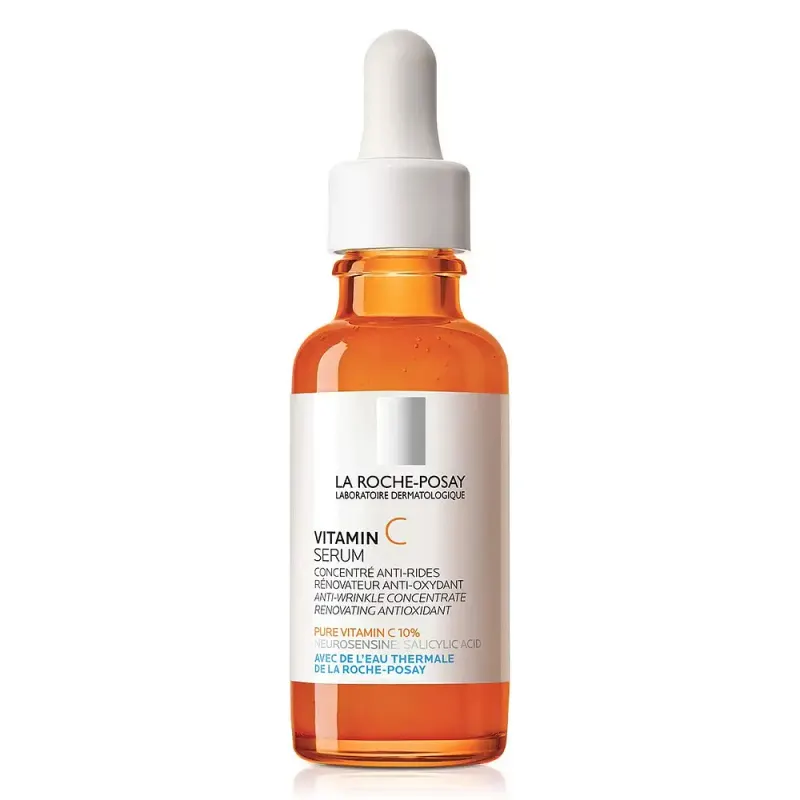
La Roche-Posay 10% Pure Vitamin C Serum by La Roche-Posay
La Roche-Posay

La Roche-Posay 10% Pure Vitamin C Serum

Serums

Safety score

Pregnancy-focused assessment

Medium Risk58/100
Higher concernLower concern

This formula contains an ingredient that needs extra caution in MamaSkin's pregnancy-focused assessment.

Formula and assessment check

Ingredient safety review updated 15 February 2026. Product formulas can change, so compare the ingredients shown here with the packaging you have.

Report a formula mismatch

Ingredient breakdown

See how the listed formula falls across MamaSkin's pregnancy-focused risk bands.

22

No known risks

6

Low risk

1

Medium risk

0

High risk

Ingredients

Ingredients with a higher risk flag appear first, followed by the rest of the formula.

BHT

Medium Risk

BHT (butylated hydroxytoluene) is a lipophilic antioxidant used to protect oils from oxidation. Animal studies at high (primarily oral) doses show liver enzyme induction and related biochemical changes; endocrine-screening lines of evidence have also been evaluated in regulatory reviews. Pregnancy-specific human outcome data for topical cosmetic exposure are limited; the key signal is systemic toxicology at higher exposures and uncertainty for pregnancy-specific outcomes.

Sources: SCCS/1636/21: Butylated hydroxytoluene https://health.ec.europa.eu/publications/butylated-hydroxytoluene-bht_en
Parfum

Low Risk

Umbrella term for an undisclosed fragrance blend. It’s not usually a pregnancy-specific concern at normal cosmetic use levels, but the exact components and concentrations aren’t fully disclosed on the label, so we score it more conservatively. If you prefer maximum transparency (or you’re sensitive to fragrance compounds), choose fragrance-free/unscented products.

Sources: SCCS: Fragrance allergens in cosmetic products https://health.ec.europa.eu/latest-updates/sccs-new-opinion-fragrance-allergens-cosmetic-products-2012-07-31_en

Cyclohexasiloxane

Low Risk

A volatile cyclic silicone also known as D6, used for slip and quick-drying texture. Normal topical exposure is expected to be limited, but exact-ingredient pregnancy evidence is limited and cyclic siloxanes have route-specific toxicology and regulatory considerations. MamaSkin therefore classifies it as low risk rather than a pregnancy contraindication.

Sources: CIR: Safety Assessment of Cyclomethicone https://cir-safety.org/ingredient/cyclomethicone; ECHA: Octamethylcyclotetrasiloxane, Decamethylcyclopentasiloxane and Dodecamethylcyclohexasiloxane restriction https://echa.europa.eu/hot-topics/siloxanes

Show all (29)

Polysilicone-11

Low Risk

A crosslinked silicone elastomer used as a film former and texture ingredient. Cosmetic safety reviewers concluded that Polysilicone-11 is safe in current cosmetic use. MamaSkin classifies it as low risk for consistency with the existing silicone-polymer policy and because cosmetic-grade manufacturing should control residual starting materials, rather than because of a known pregnancy-specific contraindication.

Sources: CIR: Safety Assessment of Polysilicone-11 as Used in Cosmetics https://www.cir-safety.org/supplementaldoc/safety-assessment-polysilicone-11-used-cosmetics

Dimethicone

Low Risk

Dimethicone is a silicone polymer used as a skin protectant and slip/conditioning agent. It is considered inert with minimal dermal absorption; the main practical issues are cosmetic (feel) and occasional irritation in very sensitive users. It is not a pregnancy-specific concern in topical cosmetic use.

Sources: CIR: Amended Safety Assessment of Dimethicone, Methicone, and Substituted-Methicone Polymers as Used in Cosmetics https://cir-safety.org/supplementaldoc/amended-safety-assessment-dimethicone-methicone-and-substituted-methicone-polymers-2

Salicylic Acid

Low Risk

Salicylic acid is a beta-hydroxy acid used for exfoliation and as a preservative. Exposure depends on concentration, product category, treated area, frequency, skin condition and inhalation or oral potential. Current SCCS assessments support specified cosmetic uses and restrictions; ordinary limited-area low-strength topical use is not equivalent to a professional peel, large-area leave-on treatment or oral salicylate exposure. MamaSkin retains Low Risk with those route and exposure qualifications.

Sources: SCCS/1646/22: Final Opinion on Salicylic Acid https://health.ec.europa.eu/latest-updates/sccs-final-opinion-salicylic-acid-2023-06-09_en; SCCS follow-up on children's exposure https://health.ec.europa.eu/publications/sccs-opinion-salicylic-acid-cas-no-69-72-7-ec-no-200-712-3-childrens-exposure_en

Polyacrylamide

Low Risk

A high-molecular-weight polymer used as a film former, binder and texture ingredient. Cosmetic-grade polyacrylamide is considered safe when residual acrylamide monomer is tightly controlled. MamaSkin classifies it as low risk because safety depends on manufacturing controls for the hazardous residual monomer, rather than because the finished polymer is a known pregnancy-specific hazard.

Sources: CIR: Safety Assessment and Re-Review of Polyacrylamide https://www.cir-safety.org/sites/default/files/RR_Polyacrylamide.pdf; EU Cosmetics Regulation 1223/2009, Annex III residual acrylamide limits https://eur-lex.europa.eu/legal-content/EN/TXT/?uri=CELEX%3A32009R1223

Water

No Known Risks

Ascorbic Acid

No Known Risks

Vitamin C antioxidant used to support brightness and photoprotection; functions as an antioxidant/pH adjuster in cosmetic formulas. No pregnancy-specific contraindications are identified for topical cosmetic use.

Sources: CIR (Ascorbic Acid); PubMed (NLM)

Glycerin

No Known Risks

Glycerin is a widely used humectant that supports hydration and the skin barrier, with a long safety record and no known pregnancy or breastfeeding concerns in topical cosmetic use.

Sources: CIR; EU/UK Cosmetics Regulation

Alcohol Denat.

No Known Risks

Volatile solvent used to improve texture, drying time, and penetration in some formulas. Reviewed cosmetic safety sources support current cosmetic use, with no pregnancy- or breastfeeding-specific topical concern identified in the material reviewed; the main practical issue is dryness, stinging, or barrier disruption in some users.

Sources: CIR: Safety Assessment of SD Alcohol 40, Benzyl Alcohol, and Denatured Alcohol in Cosmetic Products; EU CosIng / cosmetics regulatory inventory

Potassium Hydroxide

No Known Risks

A strongly alkaline raw material used mainly in small amounts to adjust pH or during soap manufacture. Concentrated potassium hydroxide is corrosive, but that raw-material hazard is not representative of a correctly formulated finished cosmetic. Cosmetic safety reviewers concluded that inorganic hydroxides are safe in current cosmetic uses when products are formulated to be non-irritating, with special handling conditions for depilatories and hair straighteners. No pregnancy-specific concern is identified for normal use of a compliant finished product.

Sources: CIR: Safety Assessment of Inorganic Hydroxides as Used in Cosmetics https://www.cir-safety.org/supplementaldoc/safety-assessment-inorganic-hydroxides-used-cosmetics-0

Polymethylsilsesquioxane

No Known Risks

A silicone resin used as a film former, texture enhancer and opacifying ingredient in makeup, sunscreen and skin care. The Cosmetic Ingredient Review concluded that polysilsesquioxanes including Polymethylsilsesquioxane are safe in current cosmetic use. Available evidence does not identify a pregnancy- or breastfeeding-specific concern for normal topical cosmetic exposure.

Sources: CIR: Safety Assessment of Polysilsesquioxanes as Used in Cosmetics (Final Report) https://cir-safety.org/sites/default/files/PLYSIL122017FR.pdf

Propylene Glycol

No Known Risks

Propylene glycol is a common solvent and humectant with a long history of use; it is not considered a pregnancy or breastfeeding concern in topical cosmetics, though some individuals may experience irritation in leave-on products.

Sources: CIR; EU/UK Cosmetics Regulation

Pentaerythrityl Tetraethylhexanoate

No Known Risks

A high-molecular-weight tetraester used as an emollient, binder and texture agent. Cosmetic safety reviewers concluded that pentaerythrityl tetraesters, including pentaerythrityl tetraethylhexanoate, are safe in current practices of use and concentration. Dermal penetration is expected to be low.

Sources: CIR: Safety Assessment of Pentaerythrityl Tetraesters as Used in Cosmetics https://cir-reports.cir-safety.org/view-attachment/?id=7a10a771-8e74-ec11-8943-0022482f06a6

C13-14 Isoparaffin

No Known Risks

A purified branched hydrocarbon used as an emollient, solvent and texture agent. Cosmetic safety reviewers concluded that the assessed isoparaffins, including C13-14 isoparaffin, are safe in current practices of use and concentration.

Sources: CIR: Isoparaffins conclusion, IJT 31(Suppl. 3), 2012; December 2025 Quick Reference Table https://cir-safety.org/sites/default/files/QRT-Update-Dec2025.pdf

Tocopherol

No Known Risks

Vitamin E antioxidant used to protect oils and support the skin barrier. Not associated with pregnancy-specific concerns at cosmetic exposure.

Sources: Cosmetic Ingredient Review (US); Scientific Committee on Consumer Safety (EU)

Sodium Hyaluronate

No Known Risks

Sodium hyaluronate (hyaluronic acid salt) is used for hydration and cushioning, with very low systemic absorption from topical use and no known pregnancy or breastfeeding concerns at cosmetic concentrations.

Sources: CIR; EU/UK Cosmetics Regulation

Hydrolyzed Hyaluronic Acid

No Known Risks

Humectant and skin-conditioning ingredient in the hyaluronate family. Reviewed cosmetic safety sources support current cosmetic use, with no pregnancy- or breastfeeding-specific topical concern identified in the material reviewed.

Sources: CIR: Safety Assessment of Hyaluronates as Used in Cosmetics; EU CosIng / cosmetics regulatory inventory

Adenosine

No Known Risks

Skin-conditioning ingredient commonly used in leave-on skincare. Reviewed cosmetic safety sources support normal topical use, with no pregnancy- or breastfeeding-specific topical signal identified in the material reviewed.

Sources: CIR: Safety Assessment of Adenosine Ingredients as Used in Cosmetics; EU CosIng / cosmetics regulatory inventory

Acetyl Dipeptide-1 Cetyl Ester

No Known Risks

Synthetic acetylated peptide ester used in topical soothing, skin-conditioning and anti-aging cosmetic formulas. Available cosmetic ingredient references do not identify a pregnancy- or breastfeeding-specific concern for normal topical cosmetic use.

Sources: Schagen SK. Topical Peptide Treatments with Effective Anti-Aging Results. Cosmetics. 2017;4(2):16. doi:10.3390/cosmetics4020016; EU CosIng / INCI cosmetic ingredient references.

PEG-20 Methyl Glucose Sesquistearate

No Known Risks

peg-20 methyl glucose sesquistearate is used as a cosmetic surfactant, emulsifier or conditioning agent. Relevant cosmetic-safety assessments support use when formulated to be non-irritating and with appropriate impurity controls. Local skin or eye irritation is possible at higher concentrations, but no pregnancy-specific concern was identified for normal topical or rinse-off use.

Sources: CIR safety assessments of alkyl PEG ethers, N-acyl taurates, fatty amidopropyl amines and related cosmetic surfactants https://www.cir-safety.org/sites/default/files/taurat122015FR.pdf; CIR Quick Reference Table https://cir-safety.org/sites/default/files/QRT-Update-Dec2025.pdf

Poloxamer 338

No Known Risks

poloxamer 338 is a cosmetic polymer or polymeric formulation aid. The reviewed material is distinct from any free reactive monomers; systemic dermal absorption is expected to be limited by molecular size when manufactured with appropriate impurity controls. No pregnancy-specific concern was identified for normal cosmetic use, although products should be formulated to avoid irritation.

Sources: CIR polymer safety assessments and Quick Reference Table https://cir-safety.org/sites/default/files/QRT-Update-Dec2025.pdf; European Commission CosIng ingredient inventory

Toluene Sulfonic Acid

No Known Risks

Ammonium Polyacryloyldimethyl Taurate

No Known Risks

A high-molecular-weight polymer used to thicken and stabilise formulas. Cosmetic safety reviewers concluded that acryloyldimethyltaurate polymers are safe in current cosmetic practices. Absorption of the finished polymer is expected to be limited, with residual monomers controlled during manufacture.

Sources: CIR: Safety Assessment of Acryloyldimethyltaurate Polymers as Used in Cosmetics; final report April 2017 https://cir-safety.org/sites/default/files/QRT-Update-Dec2025.pdf

Xanthan Gum

No Known Risks

Natural polysaccharide thickener used for stability and texture. Not associated with pregnancy-specific concerns.

Sources: European cosmetics regulatory framework

Caprylyl Glycol

No Known Risks

Humectant and preservative booster used to support product stability. Low systemic exposure expected from topical cosmetic use.

Sources: Scientific Committee on Consumer Safety (EU); Cosmetic Ingredient Review (US)

Disodium EDTA

No Known Risks

Disodium EDTA is a chelating agent used to improve formula stability and performance; it is considered low concern in topical cosmetic use, with no known pregnancy or breastfeeding risks at typical concentrations.

Sources: CIR; EU/UK Cosmetics Regulation

Laureth-7

No Known Risks

An ethoxylated fatty alcohol used mainly as an emulsifier, surfactant or solubiliser. Cosmetic safety reviewers concluded that alkyl PEG/PPG ethers are safe in current practices when formulated to be non-irritating. Manufacturing controls should limit residual ethylene oxide and 1,4-dioxane.

Sources: CIR: Safety Assessment of Alkyl PEG/PPG Ethers as Used in Cosmetics https://cir-safety.org/supplementaldoc/safety-assessment-alkyl-peg/ppg-ethers-used-cosmetics

Formulations can change without notice. For the most accurate result, compare this list with your packaging and scan the exact ingredient label in MamaSkin when you repurchase.

How to use this assessment

The risk band is the primary conclusion. The score adds detail within that band and should not be used to compare products as if a one-point difference were clinically meaningful.

MamaSkin provides pregnancy-focused information, not medical advice. Your midwife, GP, pharmacist or dermatologist should take priority when your circumstances differ from typical cosmetic use.

Read the full methodology