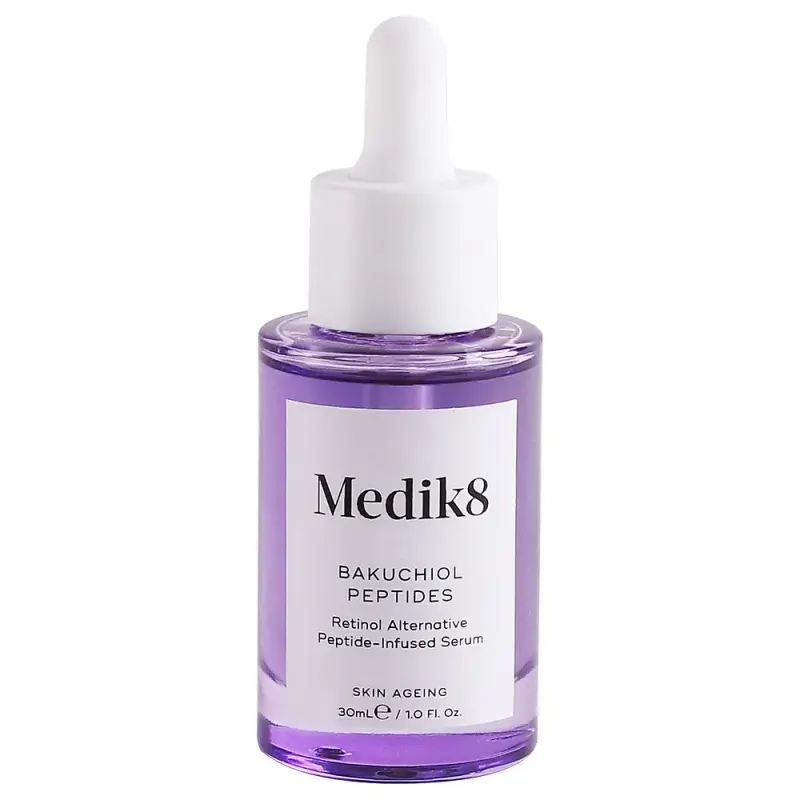
Medik8 Bakuchiol Peptides by Medik8
Medik8

Medik8 Bakuchiol Peptides

Serums

Safety score

Pregnancy-focused assessment

No Known Risks99/100
Higher concernLower concern

No higher-risk ingredients were identified in MamaSkin's current assessment. Check the latest package before deciding.

Formula and assessment check

Ingredient safety review updated 24 November 2025. Product formulas can change, so compare the ingredients shown here with the packaging you have.

Report a formula mismatch

Ingredient breakdown

See how the listed formula falls across MamaSkin's pregnancy-focused risk bands.

21

No known risks

0

Low risk

0

Medium risk

0

High risk

Ingredients

Ingredients with a higher risk flag appear first, followed by the rest of the formula.

Caprylic/Capric Triglyceride

No Known Risks

Common emollient derived from fatty acids and glycerin. Used to soften skin and improve texture without pregnancy-specific concerns.

Sources: Cosmetic Ingredient Review (US); Scientific Committee on Consumer Safety (EU)
Helianthus Annuus Seed Oil

No Known Risks

Helianthus annuus (sunflower) seed oil is a common emollient rich in fatty acids and is generally well tolerated, with no known pregnancy or breastfeeding concerns in topical cosmetic use.

Sources: CIR; EU/UK Cosmetics Regulation

Bakuchiol

No Known Risks

Bakuchiol is a plant-derived skincare ingredient used as a retinol alternative. Although it can show some retinol-like cosmetic effects, it is not a retinoid or vitamin A derivative. Human topical studies suggest good tolerability, and current literature does not identify a known pregnancy-specific risk signal for topical cosmetic use. Overall, it is generally considered a lower-concern alternative to retinoids in pregnancy, while recognising that direct pregnancy-specific studies remain limited.

Sources: PubMed (NLM): Chaudhuri & Bojanowski 2014 (PMID 24471735); Br J Dermatol bakuchiol vs retinol randomized trial (PMID 29947134); J Drugs Dermatol bakuchiol moisturizer trial in sensitive skin (PMID 33346506); J Drugs Dermatol systematic review of human topical bakuchiol trials (PMID 38564402); Contact Dermatitis case reports (PMIDs 30644106, 31423588); PMC review noting lack of pregnancy-specific studies (PMCID PMC10683784).

Show all (21)

Krameria Triandra Root Extract

No Known Risks

Plukenetia Volubilis Seed Oil

No Known Risks

A plant-derived fatty oil or butter used mainly as an emollient, conditioning ingredient or texture agent. Cosmetic safety reviewers concluded that the assessed plant-derived fatty acid oils are safe in current practices of use and concentration. This conclusion applies to cosmetic-grade fixed oils rather than similarly named volatile essential oils. Seed or food allergy may still matter for a susceptible person.

Sources: CIR: Safety Assessment of Plant-Derived Fatty Acid Oils as Used in Cosmetics https://cir-reports.cir-safety.org/view-attachment/?id=ad62ac6b-8e74-ec11-8943-0022482f06a6

Moringa Oleifera Seed Oil

No Known Risks

This plant-derived fatty oil or butter is used as an emollient and skin-conditioning ingredient. The Cosmetic Ingredient Review concluded that assessed plant-derived fatty acid oils are safe as used in cosmetics; individual plant allergy and ingredient purity remain practical considerations.

Sources: CIR: Safety Assessment of Plant-Derived Fatty Acid Oils https://cir-reports.cir-safety.org/view-attachment/?id=ad62ac6b-8e74-ec11-8943-0022482f06a6

Tocopherol

No Known Risks

Vitamin E antioxidant used to protect oils and support the skin barrier. Not associated with pregnancy-specific concerns at cosmetic exposure.

Sources: Cosmetic Ingredient Review (US); Scientific Committee on Consumer Safety (EU)
Centella Asiatica Leaf Extract

No Known Risks

A leaf extract used in soothing and skin-conditioning formulas. Cosmetic safety reviewers concluded that Centella asiatica leaf extract is safe at current cosmetic exposure when products are formulated to be non-sensitising. The assessment considered systemic and reproductive findings reported at substantially higher oral exposures; these did not establish a pregnancy-specific concern for ordinary topical cosmetic use. Centella constituents can still cause contact sensitivity in some people.

Sources: CIR: Safety Assessment of Centella asiatica-Derived Ingredients as Used in Cosmetics https://cir-safety.org/supplementaldoc/safety-assessment-centella-asiatica-derived-ingredients-used-cosmetics-1

Aloe Barbadensis Flower Extract

No Known Risks

An aloe flower extract used for skin conditioning. Cosmetic safety reviewers concluded that supported Aloe barbadensis-derived ingredients are safe in current practices, with anthraquinone impurities controlled to no more than 50 ppm. No pregnancy-specific concern was identified for normal topical cosmetic exposure.

Sources: CIR: December 2025 Quick Reference Table, Aloe Barbadensis Flower Extract conclusion https://cir-safety.org/sites/default/files/QRT-Update-Dec2025.pdf

Corallina Officinalis Extract

No Known Risks

A red-algae-derived extract used for skin conditioning, hydration or formula texture. Cosmetic safety reviewers concluded that the assessed red algae ingredients, including this extract, are safe in current practices of use and concentration. Cosmetic manufacturers should control naturally occurring contaminants such as heavy metals and arsenic.

Sources: CIR: Safety Assessment of Red Algae-Derived Ingredients as Used in Cosmetics https://cir-reports.cir-safety.org/view-attachment/?id=cef5b6e9-8c74-ec11-8943-0022482f06a6

Coccinia Indica Fruit Extract

No Known Risks

An ivy-gourd fruit extract used for skin conditioning and antioxidant support. No pregnancy- or breastfeeding-specific hazard was identified for normal topical cosmetic exposure. Direct ingredient-specific pregnancy studies were not identified, so this assessment does not extend to oral supplements or medicinal use.

Sources: European Commission CosIng ingredient inventory; Cosmetic Ingredient Review botanical safety-assessment framework and relevant ingredient-family assessments. No ingredient-specific human pregnancy study of normal topical cosmetic use was identified.

Solanum Melongena Fruit Extract

No Known Risks

A fruit, seed or food-plant extract used for skin conditioning and antioxidant support. No pregnancy-specific signal was identified for the low topical exposure expected from a finished cosmetic. Direct pregnancy studies are generally unavailable, and botanical allergy remains possible.

Sources: European Commission CosIng ingredient inventory; CIR botanical safety framework and relevant fruit-derived ingredient assessments; peer-reviewed cosmetic and phytochemical literature for the named plants.

Simmondsia Chinensis Seed Oil

No Known Risks

Plant-derived emollient oil used to soften skin and improve formula feel. Reviewed cosmetic safety sources support current cosmetic use, with no pregnancy- or breastfeeding-specific topical concern identified in the material reviewed.

Sources: CIR: Final Report on the Safety Assessment of Simmondsia Chinensis (Jojoba) Seed Oil and related jojoba-derived ingredients; EU CosIng / cosmetics regulatory inventory

Curcuma Longa Root Extract

No Known Risks

Turmeric root extract is used for antioxidant and skin-conditioning effects. Pregnancy cautions relate mainly to concentrated oral supplements; normal topical cosmetic exposure is substantially smaller. The principal topical concern is irritation or allergy in sensitive users.

Sources: NIH NCCIH: Turmeric safety, including separate oral-supplement and topical cautions https://www.nccih.nih.gov/health/turmeric; European Commission CosIng ingredient inventory.

Ocimum Basilicum Flower/Leaf Extract

No Known Risks

A botanical extract or plant water used for conditioning, soothing or antioxidant support. Direct pregnancy studies of this exact cosmetic material were not identified, but no reproductive or developmental hazard was identified for normal topical exposure. Oral herbal or medicinal use is outside this classification.

Sources: European Commission CosIng; CIR botanical safety framework and relevant plant-family assessments; no ingredient-specific human pregnancy study of normal topical cosmetic use was identified.

Ocimum Sanctum Leaf Extract

No Known Risks

Holy basil leaf extract is used for antioxidant and skin-conditioning purposes. Available warnings and pharmacology largely concern oral herbal use. No pregnancy-specific systemic hazard was identified for normal topical exposure to a compliant cosmetic, although botanical sensitivity remains possible.

Sources: PubMed: oral toxicological evaluation of Ocimum sanctum leaf extract https://pubmed.ncbi.nlm.nih.gov/24616736/; European Commission CosIng ingredient inventory. No human pregnancy study of topical cosmetic use was identified.

Eclipta Prostrata Extract

No Known Risks

A plant-part extract used for skin conditioning, soothing, fragrance or antioxidant support. No pregnancy-specific systemic signal was identified for normal topical cosmetic exposure. This assessment does not extend to essential oils, oral herbal products or medicinal doses, and botanical sensitivity remains possible.

Sources: European Commission CosIng ingredient inventory; CIR botanical safety framework and relevant plant-derived ingredient assessments; peer-reviewed cosmetic-use literature.

Melia Azadirachta Leaf Extract

No Known Risks

Neem leaf extract is used topically for skin conditioning and antimicrobial support. Reproductive concerns reported for concentrated neem seed preparations, intrauterine exposure, or high oral doses do not establish a hazard from normal topical cosmetic exposure to a leaf extract.

Sources: PubMed: oral purified neem seed extracts in primates https://pubmed.ncbi.nlm.nih.gov/8773426/; PubMed: intrauterine neem oil in primates https://pubmed.ncbi.nlm.nih.gov/8143455/; European Commission CosIng ingredient inventory. No human pregnancy study of normal topical cosmetic leaf-extract use was identified.

Melia Azadirachta Flower Extract

No Known Risks

Neem flower extract is used as a botanical skin-conditioning ingredient. A high-dose oral rat study altered the oestrous cycle and ovulation but did not show anti-implantation, abortifacient, or teratogenic effects. That oral dose does not establish a hazard from normal topical cosmetic exposure.

Sources: PubMed: high-dose oral neem flower extract reproductive study in rats https://pubmed.ncbi.nlm.nih.gov/19357745/; European Commission CosIng ingredient inventory. No human pregnancy study of normal topical cosmetic use was identified.

Undecylenoyl Phenylalanine

No Known Risks

Olea Europaea Fruit Oil

No Known Risks

Olive-derived emollient oil used for skin conditioning and barrier feel. Normal topical cosmetic use has no known pregnancy- or breastfeeding-specific concern identified in reviewed cosmetic references.

Sources: CIR: Safety Assessment of Plant-Derived Fatty Acid Oils as Used in Cosmetics; EU CosIng / cosmetics regulatory inventory

Formulations can change without notice. For the most accurate result, compare this list with your packaging and scan the exact ingredient label in MamaSkin when you repurchase.

How to use this assessment

The risk band is the primary conclusion. The score adds detail within that band and should not be used to compare products as if a one-point difference were clinically meaningful.

MamaSkin provides pregnancy-focused information, not medical advice. Your midwife, GP, pharmacist or dermatologist should take priority when your circumstances differ from typical cosmetic use.

Read the full methodology