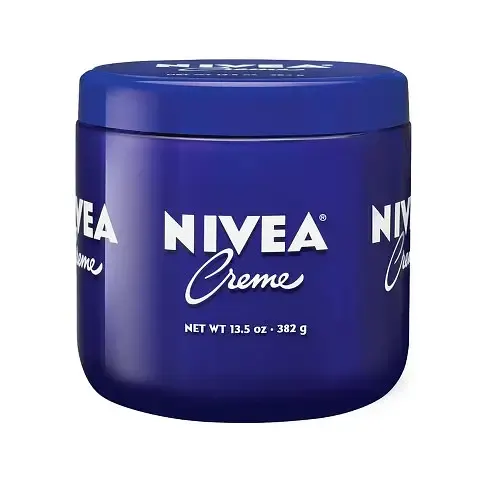
Nivea Crème by Nivea
Nivea

Nivea Crème

General Moisturizersmoisturisers

Safety score

Pregnancy-focused assessment

Low Risk76/100
Higher concernLower concern

One or more ingredients have a low-risk flag in MamaSkin's current assessment. Review the notes and your own circumstances.

Formula and assessment check

Ingredient safety review updated 23 November 2025. Product formulas can change, so compare the ingredients shown here with the packaging you have.

Report a formula mismatch

Ingredient breakdown

See how the listed formula falls across MamaSkin's pregnancy-focused risk bands.

15

No known risks

1

Low risk

0

Medium risk

0

High risk

Ingredients

Ingredients with a higher risk flag appear first, followed by the rest of the formula.

Parfum

Low Risk

Umbrella term for an undisclosed fragrance blend. It’s not usually a pregnancy-specific concern at normal cosmetic use levels, but the exact components and concentrations aren’t fully disclosed on the label, so we score it more conservatively. If you prefer maximum transparency (or you’re sensitive to fragrance compounds), choose fragrance-free/unscented products.

Sources: SCCS: Fragrance allergens in cosmetic products https://health.ec.europa.eu/latest-updates/sccs-new-opinion-fragrance-allergens-cosmetic-products-2012-07-31_en
Water

No Known Risks

Paraffinum Liquidum

No Known Risks

Highly refined mineral oil (occlusive emollient). Cosmetic-grade mineral oil has very low skin absorption and is widely considered safe for topical use during pregnancy when used as intended. Concerns raised online typically relate to unrefined/poorly refined mineral oils and dietary mineral oil hydrocarbons, not regulated cosmetic-grade topical use.

Sources: BfR (Federal Institute for Risk Assessment), Highly refined mineral oils in cosmetics: Health risks are not to be expected according to current knowledge (2018). ; Petry et al., Review of data on the dermal penetration of mineral oils and waxes used in cosmetic products (Food and Chemical Toxicology, 2017). ; EFSA, Scientific Opinion on Mineral Oil Hydrocarbons in Food (2012).

Show all (16)

Petrolatum

No Known Risks

Highly refined petrolatum (petroleum jelly) is a skin protectant/occlusive with minimal dermal penetration; safety depends on refining/PAH impurity controls and cosmetic/medical grades meet established standards.

Sources: USP White Petrolatum monograph (2021); Petry et al., Food and Chemical Toxicology (2017); PubMed (dermatology review)

Glycerin

No Known Risks

Glycerin is a widely used humectant that supports hydration and the skin barrier, with a long safety record and no known pregnancy or breastfeeding concerns in topical cosmetic use.

Sources: CIR; EU/UK Cosmetics Regulation

Microcrystalline Wax

No Known Risks

Highly refined mineral wax used to thicken and stabilise formulas. Cosmetic-grade microcrystalline wax has minimal skin absorption and no known pregnancy-specific concerns in topical use as intended. Concerns raised online typically relate to unrefined mineral oil impurities or dietary exposure, not cosmetic-grade topical use.

Sources: Cosmetic Ingredient Review (CIR) ingredient dossier for Microcrystalline Wax + CIR wax safety assessment materials. ; Petry et al. (2017) dermal penetration review (includes mineral oils/waxes). ; BfR, Highly refined mineral oils in cosmetics (context on refined mineral oil fractions/waxes in cosmetics) (2018).

Lanolin Alcohol

No Known Risks

lanolin alcohol is a cosmetic formulation, mineral, sugar-derived or organic-acid ingredient. Available identity, use and related safety evidence did not identify a pregnancy-specific concern for normal topical cosmetic exposure. Cosmetic-grade purity and ordinary irritation precautions remain applicable.

Sources: CIR ingredient and related-family safety assessments; CIR Quick Reference Table https://www.cir-safety.org/supplementaldoc/quick-reference-table-december-2025; European Commission CosIng

Paraffin

No Known Risks

Highly refined hydrocarbon wax used as an occlusive/thickener. Cosmetic-grade paraffin has minimal skin absorption and no known pregnancy-specific concerns in topical use as intended. Concerns raised online typically relate to unrefined mineral oil impurities or dietary exposure, not cosmetic-grade topical use.

Sources: Cosmetic Ingredient Review (CIR), Safety Assessment of Fossil and Synthetic Waxes as Used in Cosmetics (2025); BfR, Highly refined mineral oils in cosmetics (2018). ; Petry et al. (2017) dermal penetration review.

Magnesium Sulfate

No Known Risks

Inorganic salt used as a viscosity-control, bulking or stabilizing ingredient in cosmetics. Reviewed cosmetic ingredient references do not identify a pregnancy- or breastfeeding-specific concern for normal topical use.

Sources: CIR cosmetic ingredient safety references for inorganic salts; EU CosIng / cosmetics regulatory inventory

Decyl Oleate

No Known Risks

A fatty ester, triglyceride or lipid emollient. These materials have low expected systemic exposure and no pregnancy-specific hazard was identified for normal topical use.

Sources: CIR assessments of fatty esters, triglycerides and emollients; European Commission CosIng.

Octyldodecanol

No Known Risks

Fatty alcohol emollient used to improve spreadability and reduce drag. Reviewed cosmetic safety sources support normal topical use, with no pregnancy- or breastfeeding-specific topical signal identified in the material reviewed.

Sources: CIR ingredient status / report data sheet for Octyldodecanol; EU CosIng / cosmetics regulatory inventory

Aluminum Stearates

No Known Risks

Panthenol

No Known Risks

Panthenol (pro-vitamin B5) is used for soothing and barrier support and is generally well tolerated, with no known pregnancy or breastfeeding concerns in topical cosmetic use.

Sources: CIR; EU/UK Cosmetics Regulation

Citric Acid

No Known Risks

pH adjuster used in small amounts to maintain product stability. Not associated with pregnancy-specific concerns.

Sources: Scientific Committee on Consumer Safety (EU); European cosmetics regulatory framework

Magnesium Stearate

No Known Risks

A magnesium salt of stearic acid used for texture, adhesion and slip. Cosmetic safety reviewers concluded that magnesium stearate is safe in current practices when formulated to be non-irritating and non-sensitising. Loose powders should still be used without deliberately inhaling them.

Sources: CIR: Quick Reference Table and amended metallic stearates conclusion https://www.cir-safety.org/sites/default/files/sq-fix_2.pdf

Sodium Anisate

No Known Risks

The sodium salt of anisic acid, used mainly for preservative support and formula stability. No reproductive or pregnancy-specific concern was identified for the low topical exposure expected from a compliant finished cosmetic. Local irritation remains possible in a sensitive person.

Sources: European Commission CosIng ingredient inventory; European Chemicals Agency substance information for sodium anisate and anisic acid.

Formulations can change without notice. For the most accurate result, compare this list with your packaging and scan the exact ingredient label in MamaSkin when you repurchase.

How to use this assessment

The risk band is the primary conclusion. The score adds detail within that band and should not be used to compare products as if a one-point difference were clinically meaningful.

MamaSkin provides pregnancy-focused information, not medical advice. Your midwife, GP, pharmacist or dermatologist should take priority when your circumstances differ from typical cosmetic use.

Read the full methodology